
Bald Eagle


  • Kids Kingdom
Back to Animals
News
Individuals
Basic Info
Guide
Biofacts
Encyclopedia
The bald eagle is one of North America’s largest and most recognizable birds of prey, known for its striking white head, dark brown body, powerful yellow beak, and impressive wingspan that can reach over seven feet. Found near rivers, lakes, wetlands, and coastlines, bald eagles rely heavily on aquatic habitats where fish are abundant, though they will also hunt small mammals and waterfowl or scavenge carrion when available. Their exceptional eyesight allows them to spot prey from great distances while soaring high above the landscape. Bald eagles build some of the largest nests of any bird in North America, often returning to the same nesting sites year after year. Once severely threatened by habitat loss, hunting, and the effects of the pesticide DDT, bald eagle populations declined dramatically during the 20th century. Through legal protections, habitat conservation, and the banning of DDT, populations successfully recovered and the species is now considered one of the greatest wildlife conservation success stories in the United States.
The male, Justice, and the female, Liberty, sustained injuries in the wild and were rescued and rehabilitated by the Alaska Raptor Center in Sitka. The U.S. Fish and Wildlife Service determined the eagles were non-releasable due to their permanent injuries. Both eagles are adults, but their ages are unknown.


Justice
Male •
DOB: Unknown – at least 5-6 years old because they have white feathers on their head
Born At: Wild – Alaska
Date In: 08/23/2024
Markings:


Liberty
Female •
DOB: Unknown – at least 5-6 years old because they have white feathers on their head
Born At: Wild – Alaska
Date In: 08/23/2024
Markings:


Gone and Moved


Basic Information

Iconic Symbol: The bald eagle is the national bird of the United States and symbolizes strength, freedom, and independence.
Adaptability: Despite its association with wild, remote areas, bald eagles can adapt to urban environments, especially where they have access to large bodies of water.
Endangered Species Recovery: Once listed as Endangered due to hunting, habitat loss, and pesticides, their population has significantly increased following legal protections and conservation efforts.
Powerful Flyers: Bald eagles are exceptional flyers, capable of soaring at great altitudes and diving at speeds up to 100 mph (160 km/h).
Nesting: They build large nests, often on tall trees near water, which can be reused and expanded over several years.
Coloration: Juvenile bald eagles are brown, with mottled feathers that darken and change as they mature. They reach their full adult plumage at around 4-5 years of age, with the characteristic white head and tail emerging gradually.
Eye Color Changes: Juvenile eagles have dark brown eyes, which gradually lighten to yellow as they mature. The eye color change is a key indicator of aging in bald eagles and is fully noticeable by 4 years old.
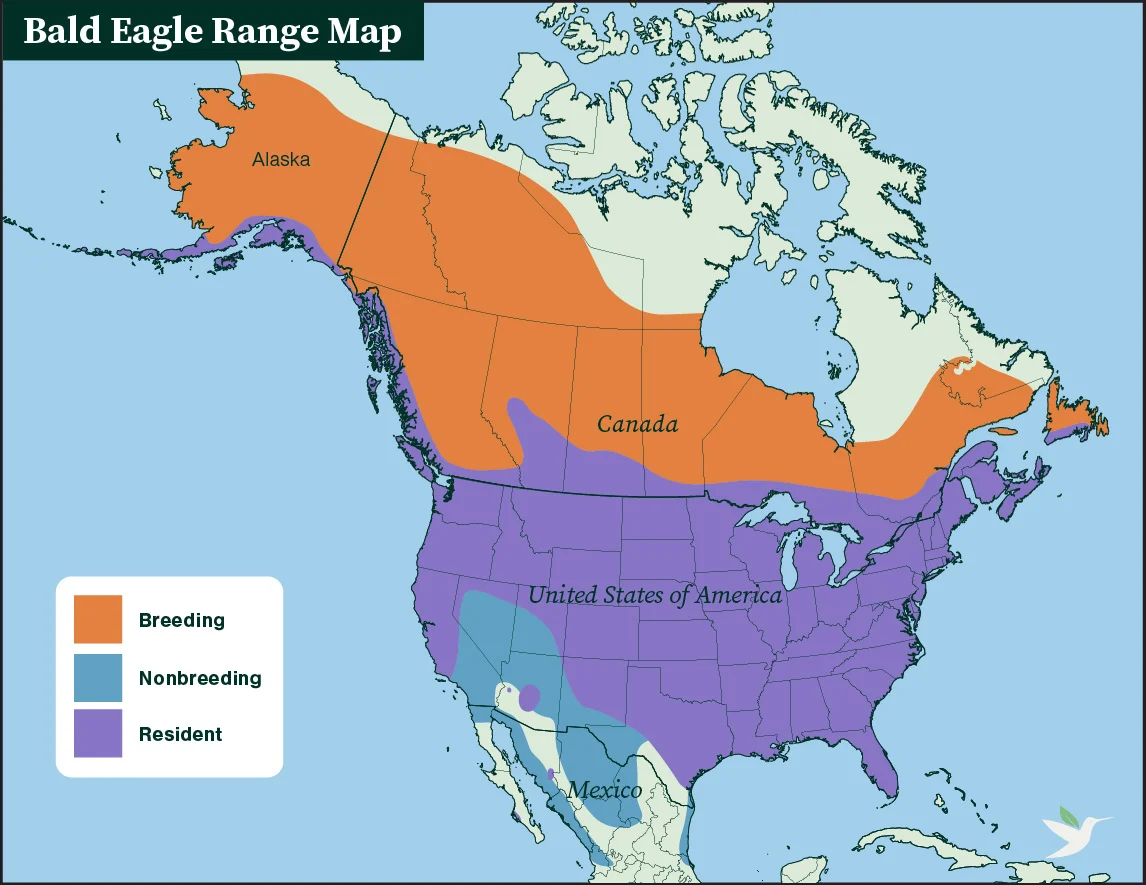
North America ranging from Alaska and Canada, across the US down to northern Mexico.Habitat
Bald eagles inhabit a variety of environments, including estuaries, large lakes, reservoirs, rivers, and some seacoasts.
They are increasingly found in drier areas that are farther from water sources, such as farmland and urban and suburban habitats.

Weigh 6.6-14 lbs. Wingspan from 5.5 feet to nearly 8 feet. Females may be up to 30% larger than males.

Mating System: Bald eagles are monogamous and often mate for life. They typically form strong, lasting bonds with their mate, especially once they establish a nesting territory.
Mating Season: The breeding season for bald eagles occurs during the winter to early spring, depending on geographic location.
Nesting: Bald eagles build large, platform-like nests in tall trees or on cliffs near water. These nests can be up to 13 feet wide and used for multiple years, being rebuilt and expanded over time.
Eggs and Incubation: The female bald eagle lays 1 to 3 eggs in a single clutch. Both the male and female take turns incubating the eggs, with the female doing most of the incubation during the day and the male taking the night shift.
Incubation Period: The incubation period lasts about 35 days, after which the eggs hatch, usually with a day or two between each chick.
Parental Care: After hatching, both parents share in feeding and caring for the chicks. The parents bring food to the nest, where the chicks are fed by tearing the food into small pieces. The young are fledged (able to fly) at around 10-12 weeks of age but remain dependent on their parents for several more weeks.
Sexual Maturity: Bald eagles reach sexual maturity at around 4 to 5 years of age when they fully develop their characteristic white head and tail feathers.

20-30 years in the wild. Under human care around 30 years but have been known to live longer in some zoos.
In the wild, they are opportunistic foragers, eating a variety of live fish, bird, and mammal prey; fish stolen from other piscivores (animal that eats fish); scavenged fish and mammals. At the Zoo they consume trout, salmon, rats (Liberty’s favorite), chicken (Justice’s favorite).
Protected under the Migratory Bird Treaty Act and the Bald and Golden Eagle Protection Act. IUCN Least Concern
316,700 in the lower 48 states as of 2020. This includes 71,400 nesting pairs.

Plumage: Mature adults have a white head and white tail with a brown body; adult plumage is attained by 5 years of age.
Juvenile Appearance: Young bald eagles (up to 4 to 5 years old) have mottled brown and white feathers and gradually develop their distinctive white head and tail.
Eye and Bill Color: They develop light eyes and bright yellow bills as they mature; juveniles have dark eyes and bills that lighten over time.
Legs: Bald eagles possess yellow legs with feathers only on the tops of their legs.
Call: Their call is unexpectedly weak for a large raptor, described as a snickering laugh, consisting of seven or eight notes, noted as “ki-ki-ki-ki-ki-ki-ker.”

Social Structure: Bald eagles are generally solitary outside of the breeding season, though they may be seen in pairs during mating season. They often congregate in large groups in areas with abundant food during winter.
Territorial: During the breeding season, bald eagles are territorial and will defend their nesting sites aggressively against intruders, including other bald eagles.
Communication: Bald eagles use a variety of vocalizations, including high-pitched whistles and chirps, particularly during the breeding season or when communicating with their mate or offspring.
Hunting and Feeding: They are primarily diurnal hunters, using their exceptional vision to spot fish from great distances. They typically hunt during the day and rely on scavenging or stealing fish from other birds like ospreys.
Soaring: Bald eagles are expert soarers. They use thermals (rising columns of warm air) to stay aloft for long periods without expending much energy. This allows them to scout for prey from high above.
Nesting: Bald eagles are known for building massive nests in tall trees or cliffs near water. These nests can be reused and expanded for several years, growing larger over time.

Why the color change? The yellow eyes in adults are thought to be a sign of maturity and possibly help with communication or visual cues during mating or territorial displays. It may also have a role in signaling the eagle’s readiness for breeding, as brighter colors in many species are associated with reproductive health.

Predators: Adult bald eagles have few natural predators due to their size and strength. However, young eagles are vulnerable to predation by larger birds of prey, such as great horned owls, or other territorial bald eagles.
Prey: Bald eagles are primarily fish eaters, hunting for salmon, trout, and other fish species. They may also hunt waterfowl, small mammals, and occasionally turtles or dead animals (scavenging carrion).
Hunting Style: They are opportunistic hunters and are known to steal fish from other birds, like ospreys, using their superior size and power. They are also skilled at diving to capture fish directly from the water.

Habitat Loss: Development of wetlands, lakes, and coastal areas for human use can destroy bald eagle nesting sites, reducing available habitat for breeding and hunting.
DDT and Pesticides: DDT, a pesticide banned in the 1970s, thinned eggshells, leading to failed reproductive attempts. Though DDT is no longer widely used, the effects of past pesticide exposure still impact some populations.
Poaching: Despite legal protections, bald eagles have been victims of illegal hunting and egg collection in certain areas.
Disturbance: Human disturbance, such as recreational activities near nesting sites or construction, can cause stress to breeding pairs and may lead to abandoned nests.
Climate Change: Climate change may affect the availability of food, particularly fish, and alter the suitable nesting habitats for bald eagles, potentially leading to population stress in certain regions.
Lead Poisoning: Some bald eagles are at risk of lead poisoning from ingesting lead shot or fishing tackle, which can contaminate their prey.

Apex Predator: As apex predators, bald eagles help maintain the balance of fish and waterfowl populations by regulating their numbers through hunting.
Scavengers: Bald eagles are also important scavengers, feeding on the remains of dead animals, which helps clean up the environment and recycles nutrients back into the ecosystem.
Ecosystem Health Indicator: The presence of bald eagles is a sign of a healthy ecosystem, particularly in wetlands and riparian habitats, indicating clean water and a stable food supply.
Keystone Species: In some areas, bald eagles play a keystone role in their ecosystems, influencing the behavior and population dynamics of other species, such as small mammals and fish.

Legal Protections: Bald eagles are protected under the Bald and Golden Eagle Protection Act and the Migratory Bird Treaty Act, which make it illegal to harm or disturb eagles or their nests.
Habitat Protection: Conservation efforts focus on protecting and restoring important wetland and riparian habitats where bald eagles nest and hunt, ensuring that these ecosystems remain viable.
Breeding Programs: Efforts are made to monitor and protect nesting sites through regular surveys and interventions when needed, such as creating buffer zones around nests to minimize human disturbance.
Public Awareness: Conservation organizations and wildlife agencies work to educate the public about the importance of protecting bald eagle habitats, reducing pollution, and supporting sustainable fishing practices.
Lead Poisoning Reduction: Efforts to reduce lead poisoning include campaigns to encourage the use of non-toxic ammunition and fishing gear, which helps protect bald eagles from ingesting lead.
Reintroduction Programs: In areas where bald eagle populations have been severely reduced, reintroduction programs have been implemented to help establish and stabilize populations.

Participate in conservation efforts: Join river clean-ups and habitat restoration along the Ohio River, where bald eagles are found.
Support sustainable fishing: Encourage the use of eco-friendly products to reduce water pollution and protect eagle habitats.
Advocate for wildlife protection: Work with local organizations like the Pittsburgh Zoo to preserve safe nesting sites and minimize human disturbance.
Volunteer: Get involved in programs that protect endangered species and promote non-toxic fishing gear to prevent lead poisoning.
Promote sustainability: Educate others about local wildlife conservation and sustainable practices that benefit bald eagles.

The Bald Eagle Population Size Report: 2020 Update provides the most current population estimate of bald eagles in the lower 48 states. The bald eagle population climbed to an estimated 316,700 individual bald eagles, including 71,400 nesting pairs.


Guest Engagement

  1. Injured Not Released
  2. Wild Eagles Visiting
  3. Fish Thief Hunter
  4. Beak Filter Grip
  5. Size Difference
  6. Color Change Timeline
  7. Massive Nests
  8. One Bird Territory
  9. Comeback Story
  10. Sacred Feathers

Injured Not Released

  • These two eagles came from the wild but were injured and could not survive on their own.
  • Federal law only allows non-releasable bald eagles to live in zoos.
  • You are looking at birds that would not have made it in the wild.
  • Injuries often affect flight or vision, which means no hunting and no escape from danger.
  • They now act as ambassador animals so people can see this species up close.

Wild Eagles Visiting

  • Wild bald eagles sometimes land in the trees around this habitat and start calling.
  • The calls travel far and signal that another eagle is nearby.
  • Liberty and Justice immediately turn and track the sound.
  • It becomes a quiet standoff where both sides watch each other.
  • This usually happens during colder months when eagles move to find food.

Fish Thief Hunter

  • Bald eagles eat mostly fish and will grab them right out of the water.
  • They also steal fish from other birds like ospreys instead of catching their own.
  • Their size and power let them bully smaller birds midair.
  • They can hit speeds close to 100 miles per hour during a dive.
  • What looks calm from here turns into a high-speed snatch over the water.

Beak and Talons

  • That hooked beak is designed to tear flesh, not chew.
  • The talons lock down with crushing grip strength once they grab prey.
  • A bald eagle can grip with about 300–400 pounds of force, similar to a large dog bite, but concentrated into sharp talons so it acts more like being pinned by spikes than squeezed.
  • They do not carry heavy fish far and often drag them to shore.
  • You might notice them shifting their feet constantly to keep balance.
  • Every part of the body is built for grabbing and ripping, not chasing.

Size Difference

  • The larger bird you see is the female, which surprises a lot of people.
  • Females can be up to 30 percent bigger than males.
  • Wingspan can reach nearly 8 feet across.
  • That size difference helps reduce competition between mates.
  • It also makes the female more dominant at the nest.

Color Change Timeline

  • Young bald eagles are completely brown, no white head at all.
  • It takes about 4 to 5 years to get the full white head and tail.
  • Their eyes also change from dark brown to bright yellow.
  • That means not every bald eagle you see in the wild looks “bald.”
  • Visitors often mistake younger birds for a different species.

Massive Nests

  • Bald eagles build some of the largest nests of any bird in North America.
  • Nests can be reused and added to year after year.
  • Some nests weigh over a thousand pounds.
  • They place them high in trees near water for a clear view.
  • That height gives early warning of threats and easy access to food.

One Bird Territory

  • Bald eagles are not social birds and defend their space.
  • Pairs control large areas around water sources.
  • Calling and perching high helps them signal ownership without fighting.
  • That same behavior is what you see when wild eagles show up here.
  • It looks calm, but it is all about territory and awareness.

Comeback Story

  • Bald eagles were nearly wiped out in the lower 48 states.
  • A pesticide called DDT caused eggshells to break before hatching.
  • Legal protection and banning DDT allowed populations to recover.
  • There are now over 300,000 eagles in the lower 48 states.
  • This is one of the most successful wildlife recoveries in the U.S.

Sacred Feathers

  • Bald eagle feathers hold deep spiritual meaning in many Native American cultures and are treated with great respect.
  • Feathers are used in ceremonies, dances, and regalia as symbols of honor, strength, and connection to the Creator.
  • Each feather can represent an act of bravery or a meaningful life event.
  • By law, only enrolled members of federally recognized tribes can legally possess eagle feathers.
  • The U.S. Fish and Wildlife Service distributes naturally molted or recovered feathers through a federal repository system.
  • This means every feather is tracked and handled with care, not collected casually from the wild.
  • What you see on this bird carries cultural meaning far beyond just flight or appearance.National Eagle Repository | What We Do | U.S. Fish & Wildlife Service

Encyclopedia

Bald Eagle

Bald eagles (Haliaeetus leucocephalus) are large birds of prey native to North America and among the most recognizable raptors in the world. Despite their name, bald eagles are not actually bald; the term derives from an older meaning of the word “bald,” referring to the bird’s striking white head. Bald eagles belong to the family Accipitridae, which includes hawks, kites, vultures, and other eagles, and are more specifically classified among the sea eagles, a group of fish-eating raptors associated with aquatic ecosystems. Revered for their immense size, powerful flight, and symbolic significance, bald eagles have become closely associated with wilderness, national identity, and wildlife conservation throughout North America.

As apex avian predators and opportunistic scavengers, bald eagles occupy an important ecological role within freshwater and coastal ecosystems. Their populations were once driven to the brink of collapse during the mid-20th century due largely to pesticide contamination, making their recovery one of the most well-known conservation success stories in modern wildlife management. Today, bald eagles are found across much of the United States, Canada, and Alaska, where they continue to serve as indicators of ecosystem health and environmental quality.

Classification and Taxonomy
Bald eagles belong to the genus Haliaeetus, commonly known as the sea eagles, a lineage of large raptors strongly associated with aquatic habitats and fish-based diets. They are closely related to other sea eagles including the white-tailed eagle of Eurasia and Steller’s sea eagle of northeastern Asia. Although often compared to golden eagles due to their similar size and broad wingspans, bald eagles differ substantially in ecology, behavior, and habitat preference. Golden eagles are more commonly associated with open terrain and terrestrial prey, whereas bald eagles are strongly tied to rivers, lakes, wetlands, and coastal systems.

The scientific name Haliaeetus leucocephalus originates from Greek and Latin roots meaning “sea eagle” and “white-headed.” Two subspecies are generally recognized: the larger northern subspecies found primarily in Alaska and Canada, and the somewhat smaller southern subspecies occurring throughout the lower continental United States and northern Mexico. Variation in body size across latitude reflects Bergmann’s rule, a biological pattern in which animals inhabiting colder climates tend to possess larger body sizes that improve heat retention.

Fossil evidence suggests that ancestral sea eagles have occupied North America for hundreds of thousands of years, adapting to glacial cycles, changing coastlines, and shifting aquatic ecosystems. Indigenous cultures throughout North America have long recognized bald eagles as spiritually and culturally important animals, frequently associating them with strength, vision, leadership, and connections between the physical and spiritual world.

Physical Characteristics
Bald eagles are among the largest birds of prey in North America. Adults typically measure between 28 and 40 inches (71 to 102 centimeters) in body length with wingspans ranging from 6 to more than 7 feet (1.8 to 2.3 meters). Females are substantially larger than males and may weigh up to 14 pounds (6.3 kilograms), while males generally weigh between 6 and 10 pounds (2.7 to 4.5 kilograms). Northern populations, particularly those in Alaska, tend to be significantly larger than southern populations.

Adult bald eagles possess dark brown body plumage contrasted sharply by a white head and tail. The bill, eyes, and feet are bright yellow, while the massive hooked beak is adapted for tearing flesh and processing prey. Juvenile bald eagles lack the distinctive white head and instead display mottled brown-and-white plumage for several years before gradually developing adult coloration. Full adult plumage is typically achieved between four and five years of age, coinciding with sexual maturity.

Bald eagles possess exceptionally powerful feet equipped with large curved talons capable of exerting tremendous gripping force. Roughened pads on the soles of the feet help secure slippery fish during capture. Their eyesight is among the most acute in the animal kingdom, allowing individuals to detect prey at considerable distances while soaring high above water or shoreline habitats. Broad wings adapted for soaring flight allow bald eagles to travel long distances efficiently using thermal air currents and coastal winds.

Habitat and Behavior

Habitat and Distribution
Bald eagles are distributed widely across North America, ranging from Alaska and northern Canada through the continental United States and into northern Mexico. Their distribution is strongly associated with aquatic habitats capable of supporting abundant fish populations. Lakes, rivers, reservoirs, estuaries, marshes, and coastal shorelines provide critical feeding opportunities as well as suitable nesting locations.

Large mature trees located near water are especially important for nesting and roosting. Bald eagles frequently select tall trees with broad visibility and strong structural support for their massive nests. In areas lacking trees, particularly parts of Alaska and coastal regions, bald eagles may nest on cliffs or rocky outcroppings. Winter distribution patterns are often influenced by prey availability and ice cover, with many northern populations migrating southward when water bodies freeze.

Although often associated with remote wilderness, bald eagles have increasingly adapted to human-modified environments including reservoirs, managed wetlands, suburban lakes, and urban waterways. Improved legal protections, reductions in pesticide contamination, and habitat restoration have contributed to expanding populations in regions where the species was once absent.

Feeding Ecology and Hunting Behavior
Fish constitute the primary component of the bald eagle diet, particularly species swimming near the water surface or concentrated in shallow habitats. Eagles typically capture prey using low gliding attacks in which the talons strike fish near the surface while the bird remains airborne. Species such as salmon, trout, catfish, carp, and herring are commonly consumed depending on regional availability.

Despite their formidable hunting abilities, bald eagles are highly opportunistic feeders. They frequently scavenge carrion, consume waterfowl and small mammals, and steal prey from other birds, especially ospreys. This behavior, known as kleptoparasitism, allows bald eagles to conserve energy by exploiting the hunting efforts of other predators. Along coastlines and river systems, eagles may congregate seasonally in large numbers during fish spawning events or migrations where prey becomes exceptionally abundant.

Winter feeding behavior often shifts toward scavenging as frozen waterways reduce hunting opportunities. Eagles may feed upon deer carcasses, waterfowl remains, or fish killed by harsh environmental conditions. Their flexible feeding ecology contributes significantly to their ability to occupy diverse habitats across a broad geographic range.

Social Structure and Communication
Bald eagles are generally solitary or pair-bonded outside of seasonal feeding aggregations. Breeding pairs establish territories centered around nesting sites and may defend these territories aggressively from intruding eagles. Pair bonds are often long-term and may persist for many years, with pairs returning repeatedly to the same nesting territories.

Communication occurs through vocalizations, body posture, aerial displays, and visual signaling. Their well-known vocal calls consist of high-pitched chirping or whistling sounds that contrast sharply with the deep cries frequently portrayed in popular media. Territorial interactions may involve dramatic aerial chases, talon-grappling displays, and synchronized flight behavior between mates.

Communal roosting sometimes occurs during winter months or periods of concentrated food availability. Large numbers of bald eagles may gather in areas supporting seasonal fish runs, particularly in Alaska and the Pacific Northwest, where salmon migrations provide abundant feeding opportunities.

Reproduction and Development
Bald eagles generally begin breeding between four and five years of age after acquiring adult plumage. Courtship behavior includes aerial displays, mutual soaring, nest-building activities, and dramatic talon-locking descents in which paired birds briefly grasp one another during flight. Nest construction typically occurs in large trees near water, though cliff nesting may occur in some regions.

Their nests are among the largest constructed by any North American bird. Built from sticks and branches and lined with softer vegetation, nests may reach over 10 feet (3 meters) in diameter and weigh more than a ton after repeated annual use and expansion. Pairs frequently reuse and enlarge nests over many breeding seasons.

Females usually lay one to three eggs, with incubation lasting approximately 35 days. Both parents participate in incubation and chick rearing. Young eaglets hatch covered in gray down and require extensive parental care during development. Competition between siblings may occur, particularly during periods of limited food availability. Juveniles typically fledge after 10 to 14 weeks but may remain dependent upon adults for additional weeks while refining flight and hunting skills.

Natural Predators and Mortality
Adult bald eagles possess few natural predators due to their size and position as apex avian predators. Eggs and young nestlings, however, may be vulnerable to predation from raccoons, ravens, gulls, great horned owls, and other opportunistic predators. Severe weather events, nest collapse, starvation, and territorial conflicts may also contribute to juvenile mortality.

Human-associated mortality remains one of the greatest threats to bald eagles. Vehicle collisions, electrocution, lead poisoning, habitat disturbance, and contamination continue to affect populations despite overall recovery. Lead toxicity resulting from ingestion of ammunition fragments in carrion remains a significant conservation concern throughout many regions.

Adaptations and Ecological Importance
Bald eagles possess numerous adaptations associated with aquatic predation and soaring flight. Their broad wings provide exceptional lift and maneuverability while minimizing energetic costs during long-distance travel. Specialized foot structures improve grip on slippery prey, while powerful neck musculature and hooked beaks allow efficient tearing of flesh.

As apex predators and scavengers, bald eagles contribute to ecosystem balance by influencing prey populations and removing carrion from aquatic and terrestrial environments. Their sensitivity to environmental contaminants and habitat degradation also makes them valuable indicator species reflecting the health of freshwater and coastal ecosystems. Population declines in bald eagles historically signaled broader ecological problems associated with chemical pollution and food-web contamination.

The species also contributes to nutrient cycling within ecosystems through scavenging behavior and transport of prey remains between aquatic and terrestrial habitats. Nest structures themselves may provide habitat opportunities for smaller birds and invertebrates over time.

Cultural Significance and Human Interest
The bald eagle has held profound cultural and spiritual importance among Indigenous peoples of North America for centuries. Eagle feathers have historically been used in ceremonies, regalia, storytelling traditions, and spiritual practices representing honor, strength, wisdom, and connection to the natural world. Many Indigenous traditions continue to regard eagles as sacred animals deserving deep respect and protection.

In 1782, the bald eagle was officially adopted as the national emblem of the United States due to its perceived symbolism of strength, independence, and resilience. Since then, the species has appeared extensively in governmental seals, military insignia, currency, monuments, and public art. Its visibility within American culture has contributed significantly to public support for wildlife conservation and environmental protection.

The dramatic recovery of bald eagle populations following severe declines has also transformed the species into a modern conservation symbol demonstrating the effectiveness of environmental legislation, habitat protection, and coordinated wildlife management efforts.

Disease and Human-Associated Threats
Bald eagles remain vulnerable to numerous human-associated threats despite population recovery. Lead poisoning from ammunition fragments in carcasses and gut piles represents one of the most significant ongoing mortality factors. Eagles ingest lead while scavenging contaminated remains, leading to neurological impairment, weakness, starvation, and death.

Habitat disturbance associated with shoreline development, logging, recreation, and expanding infrastructure may disrupt nesting behavior and reduce suitable habitat availability. Wind turbines, power lines, and vehicle collisions also contribute to mortality in some regions. Climate change may alter fish distributions, wetland systems, migration timing, and prey availability, potentially affecting future population stability.

Disease outbreaks including avian influenza and West Nile virus may also impact eagle populations, particularly where large congregations occur near feeding sites or migratory corridors.

Conservation Status and Efforts

Historical Decline and Recovery
Bald eagle populations declined catastrophically during the mid-20th century largely due to widespread use of the pesticide DDT. As DDT accumulated within aquatic food webs through biomagnification, it interfered with calcium metabolism in breeding birds, causing severe eggshell thinning. Fragile eggs frequently broke during incubation, leading to widespread reproductive failure across much of the species’ range.

By the 1960s, bald eagle populations had disappeared from many regions of the continental United States. In response, legal protections including the Bald and Golden Eagle Protection Act, the Migratory Bird Treaty Act, and later the Endangered Species Act provided critical safeguards against hunting, habitat destruction, and disturbance. The eventual ban on DDT in the United States in 1972 marked a turning point in recovery efforts.

Conservation initiatives including habitat protection, nest monitoring, captive reintroduction programs, and public education contributed substantially to population recovery. Bald eagle numbers gradually rebounded across North America, leading to the species being removed from the United States federal endangered species list in 2007.

Current Threats
Although populations have recovered significantly, bald eagles continue to face ongoing environmental pressures. Habitat fragmentation, shoreline development, pollution, lead poisoning, collisions, and climate-related ecosystem changes remain important concerns. Expanding human recreation near nesting areas may disrupt breeding behavior, particularly during incubation and chick development.

Environmental contaminants continue to accumulate within aquatic food chains, and changing climate conditions may alter prey distributions and nesting habitat stability. Increased development along waterways also reduces the availability of large mature nesting trees essential for reproduction.

Because bald eagles occupy high trophic levels within aquatic ecosystems, they remain especially vulnerable to bioaccumulation of toxins and emerging pollutants entering freshwater and marine food webs.

Conservation Organizations and Initiatives
Numerous governmental agencies, conservation organizations, Indigenous groups, and research institutions continue to monitor and protect bald eagle populations throughout North America. Conservation programs focus on habitat preservation, contaminant reduction, nest monitoring, rehabilitation, and public education regarding responsible recreation near nesting sites.

Wildlife rehabilitation centers play an important role in treating injured eagles affected by lead poisoning, collisions, electrocution, and other human-associated injuries. Scientific monitoring programs track breeding success, migration patterns, contaminant exposure, and long-term population trends to guide future management decisions.

Public support for bald eagle conservation has remained exceptionally strong due to the species’ symbolic importance and visibility within North American culture.

Role of Zoological Institutions
Accredited zoological institutions contribute to bald eagle conservation through rehabilitation partnerships, public education, veterinary care, and outreach regarding ecosystem protection and environmental contaminants. Many non-releasable bald eagles housed in zoological facilities originate from injuries that prevent survival in the wild, including wing damage, blindness, or lead toxicity.

These ambassador animals provide opportunities for public engagement and education concerning raptor biology, habitat conservation, and the broader ecological importance of healthy aquatic systems. Zoological institutions also support conservation research, wildlife medicine, and rehabilitation training programs.

Conservation Action
Individuals can support bald eagle conservation by protecting waterways, reducing pollution, properly disposing of fishing materials, avoiding disturbance near nesting areas, and using non-lead ammunition where possible. Supporting wetland conservation, sustainable fisheries management, and accredited wildlife conservation organizations also contributes to long-term protection of eagle habitats and prey systems.

The recovery of the bald eagle represents one of the most significant wildlife conservation achievements in North American history. However, continued protection of aquatic ecosystems, nesting habitat, and environmental quality remains essential to ensuring that future generations continue to observe these iconic raptors throughout the continent.

References

Lasted Updated

Views: 0

© 2026 Pittsburgh Zoo Docents