
Red Panda
Forest Passage
The red panda, often called the “firefox” or “lesser panda,” is a small, tree-dwelling mammal native to the dense, temperate forests of the Himalayas and central China. Despite its name, the red panda is not closely related to the giant panda but instead belongs to its own unique family, Ailuridae, within the order Carnivora. Known for its striking rust-colored fur, bushy tail, and gentle demeanor, the red panda has captured the hearts of people worldwide.
This endangered species plays a crucial role in its ecosystem, acting as a bamboo specialist and contributing to forest health. However, red pandas face growing threats from habitat loss, poaching, and climate change, making conservation efforts essential. Their shy, solitary nature and elusive behavior, combined with their charming appearance, make them a beloved symbol of conservation and biodiversity.

Marcy moved to Cincinnati Zoo in Nov 2025
Basic Information
Taxonomy: Part of the order Carnivora, though its diet is primarily herbivorous.
Not Pandas: Despite the name, red pandas are not related to Giant Pandas. They belong to their own family, Ailuridae, and are more closely related to raccoons and skunks.
Name Meaning: “Panda” translates to “bamboo eater” in Nepalese.
Discovery History: Red pandas were discovered first in 1825; Giant Pandas were discovered later in 1869.
Distinctive Appearance: Known for rust-colored fur, a bushy tail, and unique facial markings that can glow in the dark.
Diet: Primarily eats bamboo, supplemented by fruits, acorns, and insects.
Thumb-like Wrist: A modified wrist bone acts like a thumb, helping grasp bamboo.
Solitary and Nocturnal: Shy, mostly solitary, and active at night, with exceptional climbing skills.
Habitat: Found in cold, dense forests of the Himalayas and parts of China. Their habitat contains vegetation similar to Appalachia, including rhododendrons, chestnuts, and magnolia trees.
Fossil Records: Fossils of red panda ancestors have been found in North America. An “Appalachian Red Panda” lived in what is now Tennessee about 7–5 million years ago.
Conservation Status: Endangered due to habitat loss, poaching, and climate change.
Forest Restoration: Conservation programs replant forests using seeds found in red panda scat. Although over 80 bamboo species grow in Nepal, red pandas eat only 2–3 species. Seeds from their scat have higher germination rates and help restore native habitats.
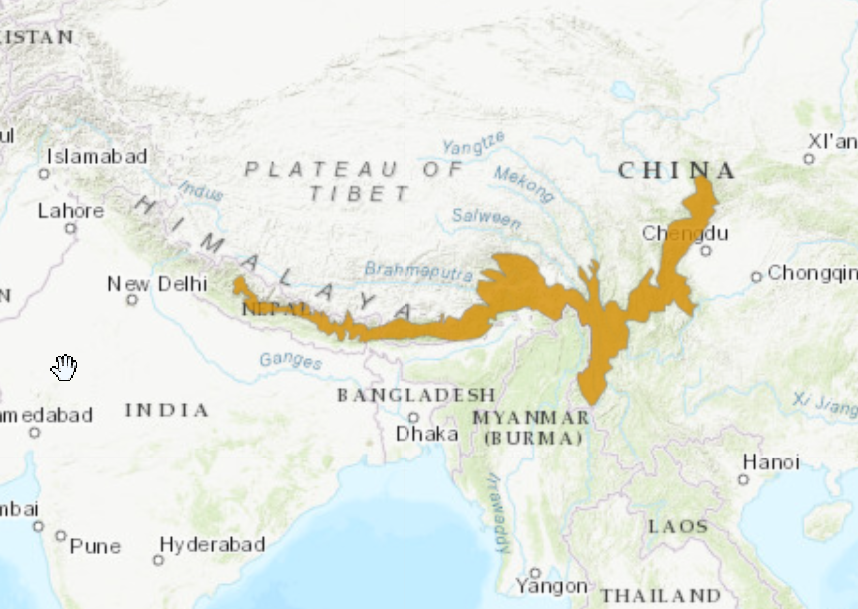
Nepal, northeastern India, Bhutan, Myanmar and central ChinaHabitat
Elevation: They thrive at elevations between 4,000 and 13,000 feet, where conditions are ideal for their survival.
Environment: Red pandas exclusively live in temperate forests characterized by steady, cool temperatures, which provide the dense canopy and bamboo resources essential to their diet and lifestyle.
Reproductive Season: Red pandas typically breed between January and March during the cooler months in their temperate forest habitats.
Mating: During breeding season, red pandas become more vocal and active. Males and females interact briefly, as they are otherwise solitary animals.
Gestation Period: Gestation lasts about 134 days, though it can vary slightly.
Litter Size: Females usually give birth to 1 to 4 cubs, with 2 cubs being most common.
Birthing Location: Mothers build nests in tree hollows, dense bamboo thickets, or rock crevices to provide a safe, insulated space for their young.
Parental Care: Mothers are highly attentive, cleaning and feeding cubs while rarely leaving the nest.
Nest Development: Cubs remain in the nest for about 3 months before beginning to explore outside.
Maturity: Cubs stay with their mothers until about 8 to 10 months old, when they are fully weaned and capable of independent survival.
Sexual Maturity: Red pandas reach sexual maturity at about 18 months to 2 years of age.

Size: Red pandas are about the size of a house cat.
Tail: They have large, bushy tails about 18 inches long that help provide balance in trees and keep them warm.
Fur: Their fur is russet-colored with black limbs and belly fur, along with white markings on the sides of the face and above the eyes.
Luminescent Face: The white facial markings almost glow and may help guide lost cubs in the dark.
Arboreal Lifestyle: Red pandas spend most of their lives in trees, sleeping in nests built in evergreen trees.
Activity: Most active at dusk, dawn, and during nighttime hours.
Feeding and Metabolism: Red pandas can spend up to 13 hours a day searching for food and have a very low metabolic rate to conserve energy. During extremely cold temperatures, they may become dormant, lowering their metabolic rate and periodically waking to search for food.
Activity Patterns: Crepuscular animals that are most active during dawn and dusk, with some nighttime activity.
Feeding: Red pandas may spend up to 13 hours a day searching for food. Their diet mainly consists of bamboo, but they also eat fruits, berries, insects, and small mammals.
Territorial: Generally solitary except during mating season. They mark territory using scent glands on their feet and anal area, as well as through urination and rubbing against objects.
Communication: Communicate through whistles, squeals, huffs, body posture, head bobbing, and tail flicking.
Thumb-like Wrist: A modified wrist bone acts like a thumb, helping grasp bamboo while feeding.
Dietary Adaptation: Adapted to eat and digest bamboo, supplemented by fruits and insects.
Adaptation to Cold: Thick, woolly fur covers the entire body, including the soles of the feet, helping retain warmth and prevent slipping on icy branches.
Snow Leopards: One of the main natural predators of red pandas in the Himalayan region. Snow leopards are skilled climbers and may prey on red pandas, especially when they are on the ground.
Martens: Small carnivorous mammals that may prey on unprotected red panda cubs in nests.
Birds of Prey: Large raptors such as eagles may target red panda cubs, particularly in exposed tree nests.
Habitat Loss: Deforestation, agriculture, road construction, and human encroachment in the Himalayas and parts of China continue to fragment red panda habitat.
Livestock Herding: Grazing livestock compete with red pandas for habitat space and can damage bamboo forests through overgrazing and trampling.
Free-roaming Dogs and Disease: Domestic dogs may attack red pandas or spread diseases such as canine distemper into wild populations.
Poaching: Red pandas are targeted for their fur and illegally captured for the exotic pet trade.
Bamboo Lifecycle: Bamboo naturally undergoes cycles of mass flowering followed by die-off. In fragmented or disturbed forests, bamboo may struggle to recover, creating food shortages for red pandas.
Habitat Fragmentation: Isolated forest patches make it harder for red pandas to find mates and maintain healthy genetic diversity.
Climate Change: Rising temperatures threaten the cool mountain forests and bamboo ecosystems red pandas depend on.
Low Reproductive Rate: Red pandas produce relatively few offspring, making population recovery slow after declines.
Human Disturbance: Expanding tourism, roads, and development increase stress and disturbance in red panda habitats.
Forest Degradation: Logging and fuelwood collection reduce tree cover and nesting areas needed for shelter and protection.
Bamboo Control: Help regulate bamboo growth, preventing it from overtaking other plant species.
Umbrella Species: Red pandas are considered an umbrella species for the Eastern Himalayan Broadleaf Ecosystem, one of the most biodiverse ecosystems in the world, supporting species such as pangolins and Himalayan black bears.
Seed Dispersal: Contribute to forest regeneration and plant growth through seed dispersal.
Indicator Species: The presence of red pandas can indicate the overall health of forest ecosystems.
Habitat Protection: Conservation efforts focus on protecting and restoring temperate forest habitats through protected areas, reforestation, and sustainable land management.
Captive Breeding: Zoo breeding programs help maintain genetic diversity and support long-term population stability for red pandas in human care.
Community Engagement: Local communities are encouraged to participate in sustainable forestry, ecotourism, and conservation practices that reduce habitat destruction and human-wildlife conflict.
Monitoring and Research: Scientists use tracking collars, camera traps, and field surveys to monitor populations, habitat use, and conservation challenges.
People Among Pandas: Community-based conservation programs provide education, sustainable employment, and environmental stewardship opportunities for local people living near red panda habitats.
Forest Restoration: Replanting native trees and bamboo species helps reconnect fragmented habitats and improve food availability.
Anti-Poaching Efforts: Increased patrols, wildlife laws, and public awareness campaigns help combat illegal hunting and the exotic pet trade.
Wildlife Corridors: Conservation groups work to connect isolated forest patches so red pandas can safely move between habitats and maintain genetic diversity.
Education Programs: Zoos, schools, and conservation organizations help raise awareness about the threats facing red pandas and the importance of protecting forest ecosystems.
International Collaboration: Governments, zoos, and conservation groups across multiple countries work together to share research, funding, and conservation strategies.
Visit or Donate: Support the Pittsburgh Zoo & Aquarium. Every visit and donation contributes to the care of red pandas and supports programs like SAFE (Saving Animals From Extinction) Red Panda and partnerships with the Red Panda Network that help protect red pandas in the wild.
Avoid Exotic Pet Content: Do not like, share, or comment on social media posts featuring exotic animals as pets, as increased visibility can fuel demand for the illegal wildlife trade.
Combat Climate Change: Reduce your carbon footprint by conserving energy, lowering heating and cooling use, using public transit, biking, or carpooling when possible.
Support Sustainable Products: Choose sustainably sourced wood and paper products to help reduce deforestation in red panda habitats.
Protect Forests: Support organizations and conservation projects that preserve mountain forests and bamboo ecosystems.
Educate Others: Share accurate information about red pandas and the threats they face to help build public awareness and conservation support.
Reduce Waste: Recycle, reduce plastic use, and properly dispose of trash to lessen environmental impacts on wildlife habitats worldwide.
Reddish Fur & Nepali Roots: The red panda gets its name from its reddish-brown fur and the Nepali word “ponya,” meaning “bamboo” or “plant-eating animal.”
Original “Panda”: The word “panda” was first used to describe the red panda.
Connection to Giant Pandas: When giant pandas were later discovered, the two species were grouped together because both eat large amounts of bamboo.
Not Actually Pandas: Despite the name, red pandas are not closely related to giant pandas. They belong to their own family, Ailuridae, and are more closely related to raccoons and skunks.
Unique Thumb: Like giant pandas, red pandas have a pseudo-thumb, an extended wrist bone that helps grasp bamboo stalks while eating.
Standing Defense: When threatened, red pandas may stand on their hind legs to appear larger and intimidate predators.
Fossil Records: Fossils of red panda ancestors found in North America show that ancient relatives once had a much broader geographic range.
Guest Engagement
- The Original Panda
- Built for Tree Life
- Built for Bamboo
- Small Animal, Big Bluff
- Conservation & Threats
- Hidden History of Red Pandas
• If you ask most people to picture a panda, what animal do they think of first? Usually the giant panda, even though the red panda was actually named first.
• The word “panda” likely comes from the Nepali word “ponya,” connected to bamboo or plant eating.
• Red pandas and giant pandas are not actually close relatives, even though they share the same name.
• Scientists debated for years whether red pandas were closer to bears, raccoons, or something completely separate.
• Modern genetics eventually showed they belong to their own unique animal family called Ailuridae.
𝗕𝘂𝗶𝗹𝘁 𝗙𝗼𝗿 𝗧𝗿𝗲𝗲 𝗟𝗶𝗳𝗲
• Have you ever seen a house cat somehow balance perfectly somewhere it absolutely should not be standing? Red pandas use many of the same balancing adaptations while climbing through trees.
• Their long bushy tails work almost like a counterweight while moving across branches and also help keep them warm in cold weather.
• Thick fur on the bottoms of their feet helps provide traction and insulation, almost like built-in winter boots.
• Many visitors think the reddish fur would make them easy to spot, but it actually blends surprisingly well with mossy trees and forest vegetation.
• Red pandas are surprisingly agile and can climb down trees headfirst by rotating their ankles, something squirrels can also do.
𝗕𝘂𝗶𝗹𝘁 𝗙𝗼𝗿 𝗕𝗮𝗺𝗯𝗼𝗼
• Bamboo looks abundant in forests, but it is actually a poor food source nutritionally. So why would an animal specialize in eating it?
• Red pandas spend a huge part of their day eating because bamboo provides very little energy.
• Like giant pandas, red pandas have a “pseudo-thumb,” which is actually an enlarged wrist bone used to grip bamboo stalks.
• Even though bamboo makes up most of their diet, red pandas still have the digestive system of a carnivore, not a plant specialist.
• Scientists also study red panda scat to learn which bamboo species are most important for habitat restoration and conservation.
𝗦𝗺𝗮𝗹𝗹 𝗔𝗻𝗶𝗺𝗮𝗹, 𝗕𝗶𝗴 𝗕𝗹𝘂𝗳𝗳
• Have you ever seen a house cat try to look twice its size when startled? Red pandas use many of the same bluffing behaviors.
• When threatened, red pandas sometimes stand upright to appear larger and more intimidating.
• Instead of roaring, red pandas make chirps, squeals, huffs, and twittering sounds.
• Scientists recently discovered that red panda fur can fluoresce under ultraviolet light, meaning parts of the fur may glow under UV conditions.
• Even small predators rely heavily on body language and intimidation to avoid conflict.
𝗖𝗼𝗻𝘀𝗲𝗿𝘃𝗮𝘁𝗶𝗼𝗻 & 𝗧𝗵𝗿𝗲𝗮𝘁𝘀
• Red pandas rely heavily on bamboo forests, so habitat loss makes it much harder for them to find food and shelter.
• Roads, logging, and development can split forests into isolated patches, forcing red pandas to travel farther between feeding areas.
• Moving between fragmented habitats can expose them to more dangers, including domestic dogs and disease.
• Climate change may slowly push cool mountain habitat farther uphill, reducing available space over time.
• Conservation groups now work on reconnecting forests by planting native trees and rebuilding wildlife corridors.
𝗛𝗶𝗱𝗱𝗲𝗻 𝗛𝗶𝘀𝘁𝗼𝗿𝘆 𝗢𝗳 𝗥𝗲𝗱 𝗣𝗮𝗻𝗱𝗮𝘀
• Do you think red pandas ever lived anywhere near Pittsburgh? Probably not today, but relatives of red pandas once lived in the Appalachian region millions of years ago.
• In 2000, road construction in eastern Tennessee uncovered the famous Gray Fossil Site, which became one of the most important fossil discoveries in Appalachia.
• Scientists discovered fossils of a giant ancient red panda relative called the Appalachian red panda, or Pristinailurus bristoli.
• Unlike modern red pandas, which are about house-cat sized, this ancient relative may have been closer to the size of a large dog.
• The discovery showed that relatives of modern red pandas once lived far beyond Asia and were spread across much larger parts of the world.
Encyclopedia
Red Panda
Red pandas (Ailurus fulgens) are small arboreal mammals native to the temperate mountain forests of the Himalayas and central China. Despite their name and bamboo-based diet, red pandas are not closely related to giant pandas and instead belong to their own unique family, Ailuridae, within the order Carnivora. Often referred to as the “firefox” or “lesser panda,” red pandas are recognized for their rust-colored fur, bushy ringed tails, and distinctive white facial markings. Their elusive behavior, gentle disposition, and striking appearance have made them one of the most recognizable small carnivores in the world and an important symbol for wildlife conservation throughout Asia.
Classification and Taxonomy
Red pandas are the sole living representatives of the family Ailuridae, a distinct evolutionary lineage within Carnivora. Although they share certain dietary similarities with giant pandas, including a heavy reliance on bamboo and the presence of a modified wrist bone used for grasping vegetation, genetic and anatomical studies confirm that the two species are not closely related. Instead, red pandas are more closely associated with raccoons, skunks, and weasels. The word “panda” is believed to originate from the Nepali word “ponya,” meaning “bamboo eater” or “plant-eating animal.” Red pandas were scientifically described in 1825, more than four decades before the giant panda was documented by Western science in 1869.
Fossil evidence indicates that ancestral red pandas once occupied a much broader geographic range than today. Fossils of extinct relatives have been discovered throughout Eurasia and North America, including the so-called Appalachian red panda discovered in Tennessee, which lived approximately 7 to 5 million years ago. These discoveries suggest that the ancestors of modern red pandas were once widespread before climatic and environmental changes restricted them to isolated mountain forests in Asia.
Physical Characteristics
Red pandas are approximately the size of a domestic house cat, with a head and body length ranging from 20 to 26 inches (51 to 66 centimeters) and a bushy tail measuring 12 to 20 inches (30 to 51 centimeters) in length. Adults generally weigh between 12 and 20 pounds (5.4 to 9 kilograms). Their dense woolly fur is reddish-russet across the upper body, while the limbs and underside are dark brown to black. White markings around the eyes, cheeks, and ears create a mask-like facial pattern unique to each individual.
One of the most distinctive adaptations of the red panda is its elongated, bushy tail, which aids in balance while climbing and also serves as insulation during cold weather. When resting, red pandas frequently curl their tails around their bodies and faces to conserve heat. Their thick fur extends across the soles of their feet, providing insulation against snow and ice while also improving traction on wet or frozen branches. Like giant pandas, red pandas possess an enlarged wrist bone functioning as a pseudo-thumb, allowing them to grasp bamboo stalks and branches with considerable dexterity.
The pale markings on the face can appear almost luminescent under dim lighting conditions. Some researchers suggest these markings may assist mothers in locating cubs within dense forests or low-light conditions. Red pandas possess sharp semi-retractable claws and highly flexible ankle joints that rotate outward, adaptations that make them exceptional climbers capable of descending trees headfirst.
Habitat and Behavior
Habitat and Distribution
Red pandas inhabit the temperate montane forests of Nepal, Bhutan, northeastern India, Myanmar, and central China. Their range occurs primarily at elevations between 4,000 and 13,000 feet (1,200 to 4,000 meters), where cool temperatures, dense forest canopies, and abundant bamboo create suitable habitat conditions. These forests frequently contain rhododendrons, magnolias, chestnuts, firs, and evergreen vegetation similar in some respects to Appalachian forest ecosystems in North America.
The species depends heavily on intact forest corridors and dense bamboo understories. Because bamboo distribution can be patchy and fragmented, red pandas require connected forest habitats that allow movement between feeding and nesting areas. Habitat fragmentation caused by logging, agriculture, livestock grazing, and human development increasingly isolates populations and reduces genetic diversity.
Activity and Arboreal Lifestyle
Red pandas are highly arboreal and spend most of their lives within trees. They rest in tree hollows, evergreen branches, or sheltered nests and are most active during dawn, dusk, and nighttime hours, making them primarily crepuscular with some nocturnal behavior. During cold weather, they may reduce activity substantially and conserve energy by lowering their metabolic rate. In severe temperatures, they can enter periods of torpor-like inactivity, periodically awakening to forage before returning to rest.
Their diet is nutritionally poor and requires extensive daily feeding. Red pandas may spend up to 13 hours each day searching for and consuming food. Although classified within Carnivora, their diet consists primarily of bamboo leaves and shoots supplemented with fruits, berries, acorns, mushrooms, roots, eggs, insects, and occasionally small vertebrates. Their digestive system is relatively inefficient at processing cellulose, requiring them to consume large quantities of vegetation to meet energetic demands.
Social Structure and Communication
Red pandas are generally solitary animals outside of the breeding season. Individuals establish territories that are marked through scent glands located on the feet and anal region, as well as through urine marking and body rubbing behaviors. Territorial boundaries help reduce direct conflict between individuals occupying overlapping forest habitats.
Communication occurs through a combination of vocalizations, scent marking, and body language. Vocal sounds include whistles, squeals, grunts, huffs, and chirping calls used during breeding interactions or territorial disputes. Physical signals such as head bobbing, tail flicking, and postural displays also communicate emotional state and social intent. When threatened, red pandas may stand upright on their hind legs in an attempt to appear larger and more intimidating to predators or rivals.
Reproduction and Development
Red pandas typically breed between January and March during the cooler months of the year. During this period, individuals become more vocal and active as males and females temporarily interact for mating. Gestation lasts approximately 134 days, though delayed implantation may contribute to variation in pregnancy duration. Females usually give birth to one to four cubs, with two cubs being the most common litter size.
Prior to birth, females construct insulated nests within tree hollows, bamboo thickets, or rocky crevices lined with leaves, moss, and vegetation. Mothers provide extensive parental care, grooming and nursing cubs while minimizing time away from the nest during early development. Cubs remain within the nest for approximately three months before beginning to explore their surroundings. Juveniles typically stay with their mothers for 8 to 10 months and reach sexual maturity between 18 months and 2 years of age.
Natural Predators
Adult red pandas face predation from several carnivores within their mountain ecosystems. Snow leopards are among the primary predators in Himalayan regions and may capture red pandas when they descend to the ground. Martens may prey upon cubs or juveniles within nests, while large birds of prey such as eagles occasionally target young individuals in exposed locations. However, the greatest threats to red pandas are human-driven rather than natural.
Adaptations and Ecological Importance
Red pandas possess several specialized adaptations associated with cold mountainous environments and a bamboo-dominated diet. Their dense fur, low metabolic rate, pseudo-thumb, and climbing adaptations allow them to exploit arboreal bamboo forests efficiently while conserving energy in cold climates. Their specialized feeding ecology also contributes to ecosystem regulation.
As bamboo specialists, red pandas help regulate vegetation growth within forest ecosystems and contribute to seed dispersal through feeding and movement patterns. They are also considered an umbrella species for the Eastern Himalayan Broadleaf Forest ecosystem, one of the most biodiverse temperate ecosystems in the world. Protecting red panda habitat indirectly safeguards many additional species including pangolins, Himalayan black bears, and numerous bird and amphibian species. Because of their sensitivity to habitat disruption, red pandas also function as indicator species reflecting the health and stability of mountain forest ecosystems.
Cultural Significance and Human Interest
Red pandas have long held cultural significance throughout Himalayan regions and are widely admired for their appearance and elusive nature. Their common nickname “firefox” references both their coloration and agile movement through forest canopies. In modern conservation culture, red pandas have become ambassadors for habitat preservation, sustainable forestry, and climate awareness. Their charismatic appearance has also unfortunately contributed to illegal wildlife trade and demand for exotic pets.
Disease and Human-Associated Threats
Red pandas are vulnerable to diseases transmitted from domestic animals, particularly free-roaming dogs living near forest habitats. Habitat fragmentation increases contact between wildlife, livestock, and human settlements, elevating the risk of disease outbreaks. Domestic dogs may also directly attack red pandas or compete for habitat space.
Conservation Status and Efforts
Current Threats
Red pandas are classified as Endangered due to ongoing population declines driven by habitat destruction, fragmentation, poaching, climate change, and disease. Fewer than 2,500 mature individuals are estimated to remain in the wild. Logging, road construction, livestock grazing, and agricultural expansion continue to fragment the temperate forests on which the species depends.
The ecology of bamboo presents an additional challenge. Bamboo periodically undergoes mass flowering events followed by widespread die-offs. In fragmented or degraded forests, bamboo regeneration is often poor, reducing food availability for red panda populations already stressed by habitat loss.
Conservation Organizations and Initiatives
Numerous conservation organizations work to protect red pandas through habitat preservation, research, captive breeding, and community engagement. Efforts include reforestation programs, protected habitat corridors, anti-poaching measures, and public education initiatives. Programs such as the SAFE (Saving Animals From Extinction) Red Panda initiative and partnerships with organizations like the Red Panda Network support field conservation and scientific monitoring throughout the species’ range.
Community-based conservation programs such as “People Among Pandas” emphasize sustainable livelihoods, environmental stewardship, and local involvement in habitat protection. Researchers also study seed dispersal through red panda scat, as seeds passed through the digestive tract often demonstrate improved germination rates that help restore native vegetation.
Role of Zoological Institutions
Accredited zoological institutions contribute to red panda conservation through cooperative breeding programs designed to maintain genetic diversity within managed populations. Zoos also provide veterinary care, behavioral research opportunities, and educational outreach that increases public awareness of conservation issues affecting the species. Captive populations serve as important insurance populations while supporting research into nutrition, reproductive biology, and disease management.
Conservation Action
Individuals can support red panda conservation by reducing their carbon footprint, supporting accredited zoolical institutions and conservation organizations, avoiding engagement with illegal exotic pet content online, and promoting sustainable forestry practices. Habitat preservation, responsible tourism, and public awareness remain essential for the long-term survival of the species.
The continued survival of red pandas depends upon international cooperation, forest protection, scientific research, and sustainable coexistence between human communities and wildlife. Protecting red pandas also protects the biodiversity-rich mountain forests of the Himalayas and central China, ecosystems that support countless plant and animal species as well as human populations dependent upon healthy watershed and forest systems.
References
Red Panda Network
SAFE Red Panda Program
Smithsonian’s National Zoo and Conservation Biology Institute: Red Panda
International Union for Conservation of Nature (IUCN) Red List: Red Panda
San Diego Zoo Wildlife Alliance: Red Panda
World Wildlife Fund (WWF): Red Panda
Red Panda Adaptations and Arboreal Behavior Studies
Appalachian Fossil Red Panda Discoveries
Red Panda Captive Breeding and Species Survival Plans
Lasted Updated