
Ring Tailed Lemur
Ring-tailed lemurs (Lemur catta) are among the most recognizable lemur species, known for their black-and-white ringed tails and highly social behavior. They are endemic to Madagascar, where they play a crucial role in their ecosystem as seed dispersers and pollinators. Unlike many other lemur species, they spend significant time on the ground and live in female-dominated troops.
These lemurs are considered living fossils, sharing traits with early primates, such as opposable digits and forward-facing eyes. Their and complex social structures make them an important species for scientific research, conservation efforts, and educational programs worldwide. However, habitat destruction, hunting, and the illegal pet trade threaten their survival, placing them on the Endangered list. Conservation programs, both in the wild and in captivity, are essential for ensuring their future.
Basic Information
Distinctive Appearance – Recognizable by their black-and-white ringed tails, which they use for communication and balance.
Female Leadership – Live in female-dominated troops, a rare trait among primates.
Highly Social – Engage in grooming, vocalizations, and synchronized movements to maintain group bonds.
Ground Dwellers – Unlike most lemurs, they spend a lot of time on the ground, moving in coordinated groups.
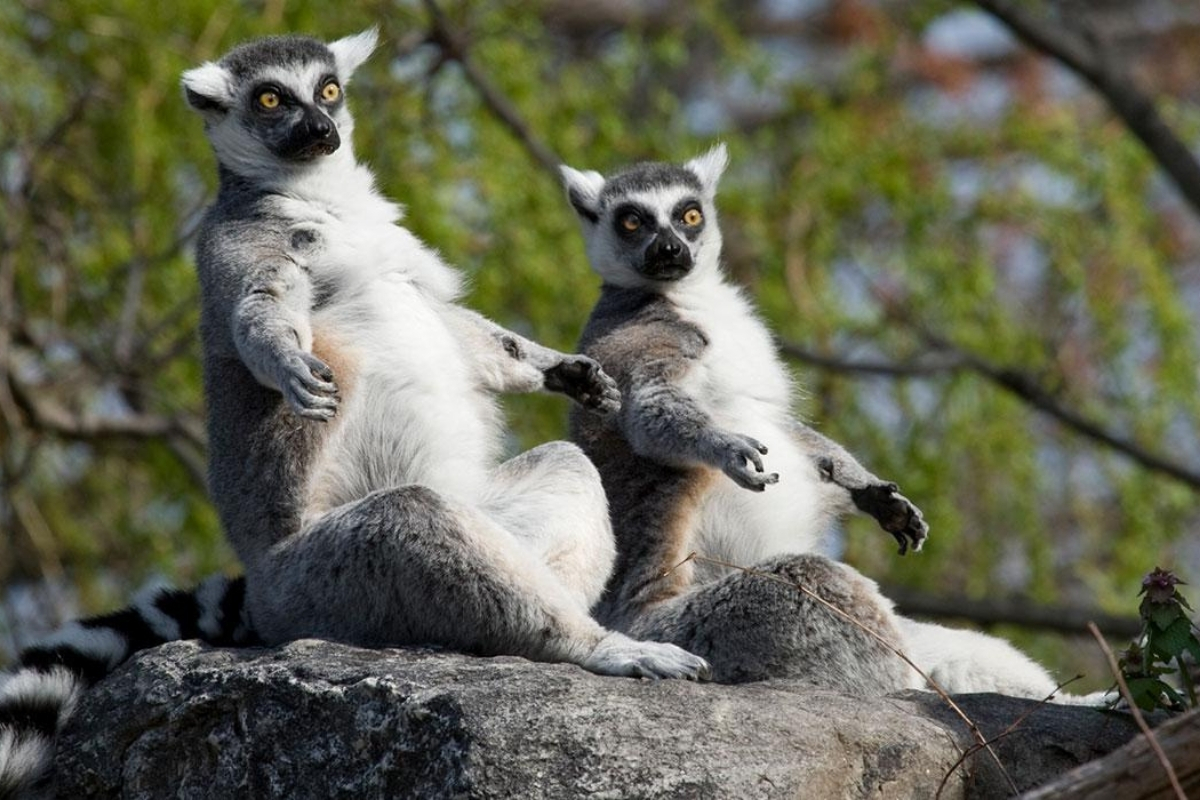
Sunbathing – Sit in a “sun-worshipping” posture with arms outstretched to absorb warmth.
Unique Communication – Use a variety of vocalizations, body language, and scent marking to communicate.
Stink Fights – Males compete by rubbing their tails with scent glands and wafting them at rivals to establish dominance.
Prehistoric Traits – Share traits with early primates, including opposable thumbs and forward-facing eyes.
Key Ecosystem Role – Act as seed dispersers and pollinators, helping regenerate Madagascar’s forests.
Conservation Status – Classified as Endangered due to habitat destruction, hunting, and the illegal pet trade.

Endemic to Madagascar (large island off the east coast of Africa, comparable in size to California, Nevada and Oregon combined), primarily in the southern and southwestern regions.
Habitat
Dry Forests & Scrublands – Prefer spiny forests, dry deciduous forests, and scrublands with mixed vegetation.
Breeding season: April–May (dry season). Typically gives birth to 1–2 infants in September–October.
Gestation: 135 days (4.5 months). Varies from 90 -135 days in different species with single (usual) and multiple offspring produced.
Mating Season – Breeds once a year, typically in April to May.
Birth Timing – Young are born in August or September, coinciding with food abundance.
Litter Size – Usually one offspring, but twins are possible.
Maternal Care – Infants cling to the mother’s belly for the first few weeks, then ride on her back.
Troop Rearing – Other females in the troop assist in caring for young, a behavior known as alloparenting.
Weaning – Begins around 8 weeks and completes by 5-6 months.
Sexual Maturity – Reached at 2.5 to 3 years for both males and females.
Distinctive Tail – Long, black-and-white striped tail (not prehensile) used for balance and communication.
Furry Coat – Soft, gray to brown fur on the back with a lighter, almost white belly.
Expressive Face – White face with dark triangular eye patches and large, round, orange eyes.
Size – About 15-18 inches long, with a tail that extends 22-25 inches; weighs around 5-7.5 lbs.
Strong Limbs – Powerful hind legs allow for agile climbing and leaping in trees.
Dexterous Hands – Fingers and toes are adapted for gripping branches and food.
Scent Glands – Have specialized glands on wrists and chest for marking territory and competing in “stink fights.”
Tooth Comb – Lower front teeth form a comb-like structure used for grooming.
Diurnal – Active during the day, primarily in the morning and late afternoon to avoid extreme heat.
Social – Live in troops of 6-30 individuals, with a dominant female leading the group.
Territorial – Mark territory using scent glands on their wrists and chest, rubbing trees and rocks.
Communication – Use vocalizations, scent marking, and body language to communicate with troop members.
Sunbathing – Often seen sitting upright with arms outstretched, absorbing warmth from the sun.
Grooming – Maintain strong social bonds through mutual grooming, using their specialized tooth comb.
Mating – Males compete for dominance during breeding season using “stink fights”, wafting scent-marked tails at rivals.
Arboreal & Terrestrial – Spend time both in trees and on the ground, more terrestrial than most other lemurs. Spend more time on the ground than any other lemur species – about 50%
Foraging – Search for food as a group, mainly eating fruits, leaves, flowers, bark, and insects.
Defense – When threatened, they may stare, lunge, and vocalize loudly; will also retreat into trees.
Striped Tail Communication – Use their black-and-white tail for troop coordination, unlike most lemurs.
Scent Marking & Stink Fights – Males rub wrist and chest glands on surfaces and wave scented tails to establish dominance.
Tooth Comb – Specialized lower teeth for grooming, unique to lemurs and some primates.
Sunbathing – Sit upright with arms outstretched, a rare primate adaptation for thermoregulation.
Terrestrial Lifestyle – Spend more time on the ground than most other lemur species.
Diurnal Activity – Active during the day, unlike many nocturnal lemurs.
Predators: Fossa, raptors, and snakes.
Prey: None (herbivorous with some opportunistic insect consumption).
Habitat Destruction – Deforestation for agriculture, logging, and charcoal production is rapidly shrinking their natural habitat in Madagascar.
Illegal Pet Trade – Captured and sold as exotic pets, leading to population declines in the wild.
Hunting & Poaching – Hunted for bushmeat despite legal protections.
Climate Change – Alters food availability and increases droughts, making survival more difficult.
Human Encroachment – Expanding villages, farms, and roads fragment their habitat, isolating populations.
Predation – Natural predators include fosas, hawks, and snakes, but human-driven habitat loss increases vulnerability.
Competition for Resources – Habitat degradation forces them into conflict with other species over food and space.
Seed Dispersers – Help regenerate forests by spreading seeds from fruits they eat.
Pollinators – Aid in pollination by feeding on nectar and transferring pollen between flowers.
Ecosystem Balance – Control insect populations by consuming various invertebrates.
Prey Species – Provide food for natural predators like fosas, hawks, and snakes, maintaining food web stability.
Habitat Indicators – Their presence reflects the health of Madagascar’s dry forests and biodiversity.
Cultural & Conservation Influence – Serve as a flagship species, driving conservation efforts that protect entire ecosystems.
Protected Areas – Found in national parks and reserves in Madagascar, such as Andringitra National Park and Anja Community Reserve.
Legal Protections – Classified as Endangered on the IUCN Red List, with hunting and trade restricted by law.
Community-Based Conservation – Programs like Anja Community Reserve engage local communities in ecotourism and habitat protection.
Captive Breeding – Over 2,000 individuals are housed in zoos worldwide as part of breeding programs to ensure genetic diversity.
Habitat Restoration – Reforestation projects and sustainable land management efforts aim to restore lost habitat.
Anti-Poaching Efforts – Conservation groups work to combat illegal pet trade and hunting through enforcement and education.
Public Awareness Campaigns – Efforts to educate local communities and international audiences about the threats to lemurs.
Choose sustainable products – Buy RSPO-certified and Fair Trade goods to reduce deforestation in Madagascar.
Reduce carbon footprint – Use public transit, bike trails, or energy-efficient appliances to combat climate change.
Avoid the exotic pet trade – Never buy or share content promoting lemurs as pets to discourage illegal trafficking.
Support sustainable tourism – Choose ethical wildlife experiences that protect lemurs instead of exploiting them.
Protect forests – Support organizations working on reforestation and conservation in Madagascar.
Educate others – Share information on lemur conservation to raise awareness and inspire action.
Prosimians, Not Monkeys – Ring-tailed lemurs are prosimians, a subgroup of primates that includes some of the most ancient and primitive primates. Unlike monkeys and apes, prosimians have better night vision, a strong sense of smell, and a more developed reliance on scent marking. They also have tooth combs for grooming and claw-like nails on some digits. Their unique traits link them closely to early primates, offering insight into primate evolution.
Guest Engagement
Encyclopedia
Lasted Updated