
Open Ocean
The Open Ocean is the aquarium’s largest exhibit, holding approximately 97,000 gallons of saltwater. It represents the warm, shallow coastal waters and reef edges of the Indo-Pacific, one of the most biodiverse marine regions in the world.
This exhibit is designed to showcase a marine ecosystem rather than individual animals. The species found here occupy different ecological niches, allowing them to coexist while competing very little for food or space. Visitors can compare how different body shapes, swimming styles, and feeding strategies help each species survive.
The exhibit features several shark species, large reef fishes, and other marine animals commonly found around Indo-Pacific coral reefs. It provides an excellent opportunity to discuss predator-prey relationships, shark adaptations, reef ecology, and marine conservation.
Behind the scenes, the Open Ocean relies on a sophisticated life support system that continuously filters and monitors the water. Maintaining stable water quality is the foundation of animal health and is the primary focus of daily aquarium operations.
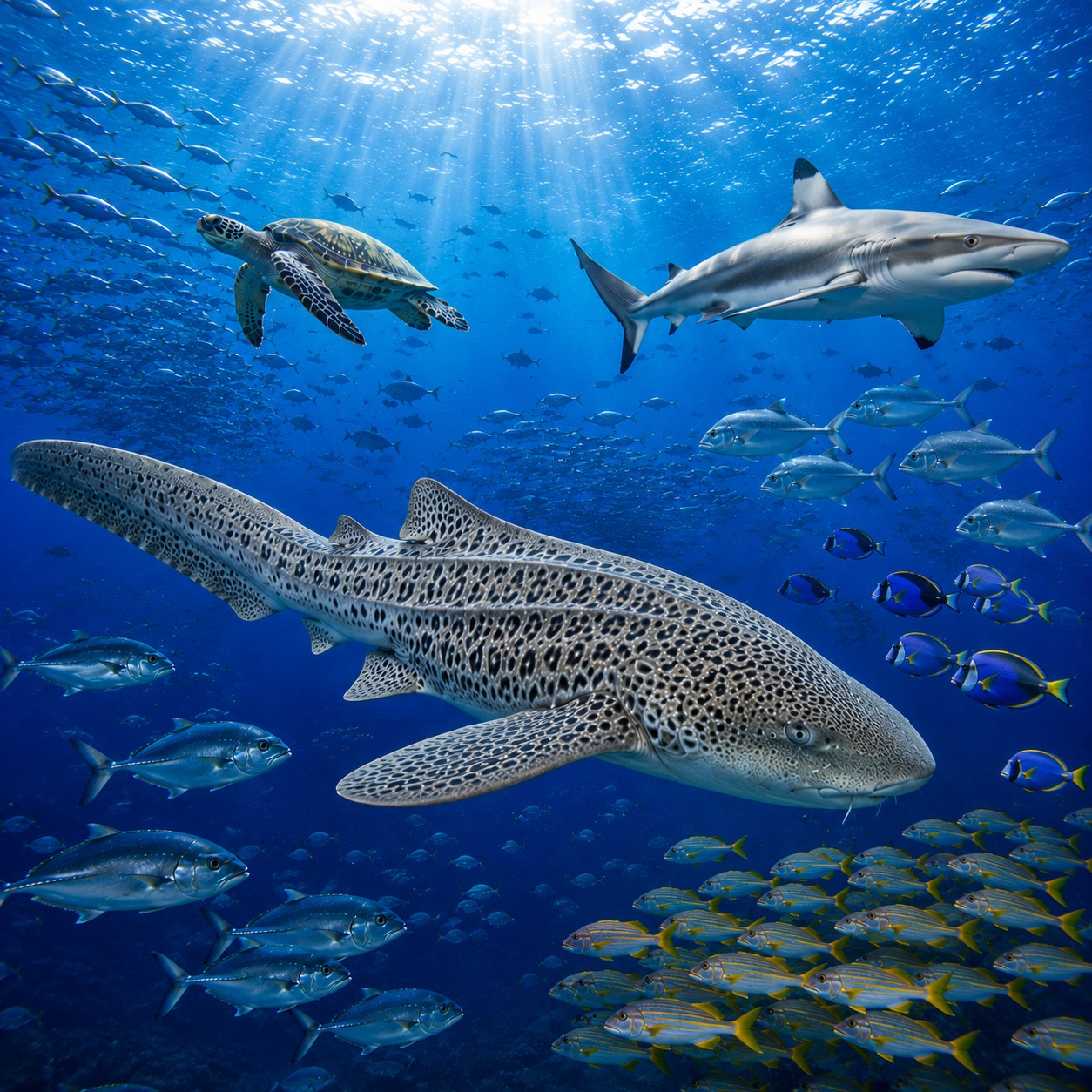
Note: Species may change, and despite every effort to ensure accuracy, errors may occur.
- Zebra Shark
- Black Tip Shark
- Green Sea Turtle (Harbor)
- Honeycomb (Lace) Moray
Zebra Shark
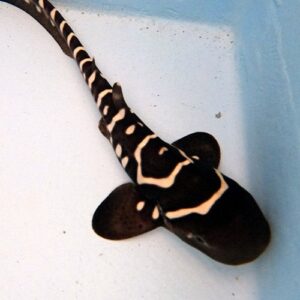
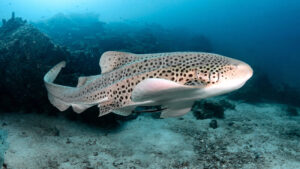
- Our sharks: Two female zebra sharks came from Guam and are 24 (2026) years old.
- Scientific name: Stegostoma tigrinum
- Conservation Status: Endangered (IUCN).
- Main Threats: Overfishing, habitat loss, and collection for the aquarium trade.
- Population Trend: Populations have declined by more than 50% over the past three generations, with some local populations disappearing entirely.
- Size: Usually 6 to 8 feet (1.8 to 2.5 m); can exceed 8 feet.
- Lifespan: 25 to 30+ years.
- Habitat: Tropical Indo-Pacific coral reefs and sandy bottoms.
- Diet: Crabs, shrimp, snails, clams, sea urchins, and small fish.
- Nutrition: Require iodine for healthy gill function.
- Behavior: Mostly solitary. Active at night; rests on the bottom during the day.
- Breathing: Can pump water over their gills while resting, unlike many sharks.
- Reproduction: Lay large leathery egg cases attached to rocks or coral.
- Skeleton: Made of cartilage, not bone.
- Appearance: Juveniles have black-and-white stripes; adults develop yellow spots.
- Animal Care: Weighed every three years. Diet is adjusted based on weight.
- Training: Target trained three times per week for husbandry, veterinary care, and enrichment.
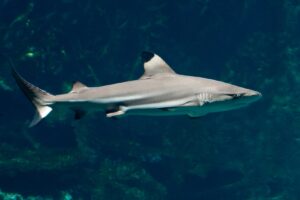 Blacktip Reef Shark
- Our sharks: Two male sharks.
- Scientific name: Carcharhinus melanopterus
- Size: Usually 4 to 5 feet (1.2 to 1.6 m); can reach about 6 feet.
- Lifespan: Approximately 12 to 15 years.
- Habitat: Shallow tropical coral reefs and coastal waters throughout the Indo-Pacific.
- Diet: Fish, squid, shrimp, crabs, and other small marine animals.
- Nutrition: Requires iodine for healthy gill function.
- Behavior: Active, fast-swimming, and constantly on the move.
- Breathing: Must swim continuously to force water over the gills (ram ventilation).
- Reproduction: Gives birth to live young, typically 2 to 5 pups after a 10 to 11 month pregnancy.
- Skeleton: Made of cartilage, not bone.
- Appearance: Distinguished by the black tips on its dorsal, pectoral, and tail fins.
- Animal Care: Weighed every three years. Diet is adjusted based on weight.
- Training: Target trained three times per week for husbandry, veterinary care, and enrichment.
Green Sea Turtle (Harbor)
Scientific Name: Chelonia mydas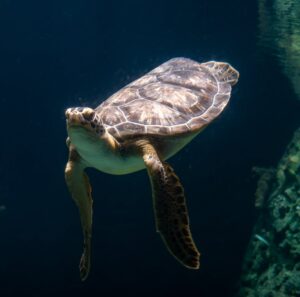
Name: Harbor
Conservation Status: Endangered (IUCN)
Size: Adults typically reach 3 to 4 feet (0.9 to 1.2 m) in shell length and weigh 240 to 420 pounds (110 to 190 kg).
Lifespan: 60 to 80+ years.
Habitat: Tropical and subtropical oceans worldwide, including coral reefs, seagrass meadows, lagoons, and coastal waters.
Diet: Adults are primarily herbivores, feeding on seagrasses and algae. Juveniles are more omnivorous.
Migration: Green sea turtles migrate hundreds to thousands of miles between feeding grounds and nesting beaches. Many females return to the same beach where they hatched to lay their eggs.
Adaptations: Their streamlined shell, powerful front flippers, and ability to hold their breath for several hours while resting make them excellent long-distance swimmers.
Ecological Role: By grazing seagrass and algae, green sea turtles help maintain healthy seagrass meadows and coral reef ecosystems that support countless marine species.
Threats: Boat strikes, entanglement in fishing gear, plastic pollution, coastal development, and climate change are major threats to wild populations.
Meet Harbor: Harbor arrived at the Pittsburgh Zoo & Aquarium in 2016 through the Sea Turtle Second Chance Program after being struck by a boat propeller in Florida. His injuries permanently paralyzed his back flippers and left him with Bubble Butt Syndrome, a condition caused by trapped air beneath his shell that makes his back end buoyant. Because Harbor cannot survive in the wild, he now serves as an ambassador, helping visitors learn how simple actions can help protect sea turtles and their ocean home.
Sleeping Behavior: Harbor often sleeps in unusual positions due to Bubble Butt Syndrome. Although he may appear injured or even dead while resting, this behavior is completely normal for him.
Honeycomb (Lace) Moray
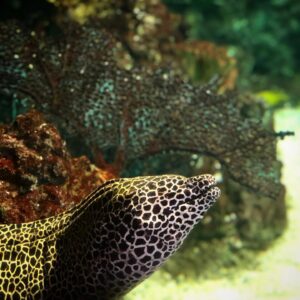
Scientific Name: Gymnothorax favagineus
Size: Usually 4 to 6 feet (1.2 to 1.8 m); can exceed 9 feet (2.7 m).
Lifespan: Approximately 20 to 30 years.
Habitat: Coral reefs, rocky crevices, and lagoons throughout the Indo-Pacific.
Diet: Fish, crabs, shrimp, octopus, and other marine animals.
Behavior: Solitary, secretive, and primarily nocturnal. Often spends the day hidden among rocks and reef crevices.
Breathing: Frequently opens and closes its mouth to pump water over its gills. This behavior is normal and is not a sign of aggression.
Special Adaptation: Possesses a second set of jaws, called pharyngeal jaws, that extend forward to grasp prey and pull it into the throat.
Appearance: Cream-colored body covered with dark brown or black honeycomb-like markings that provide camouflage among the reef.
Ecological Role: An important mid-level predator that helps regulate populations of fishes and invertebrates within coral reef ecosystems.
Basic Information
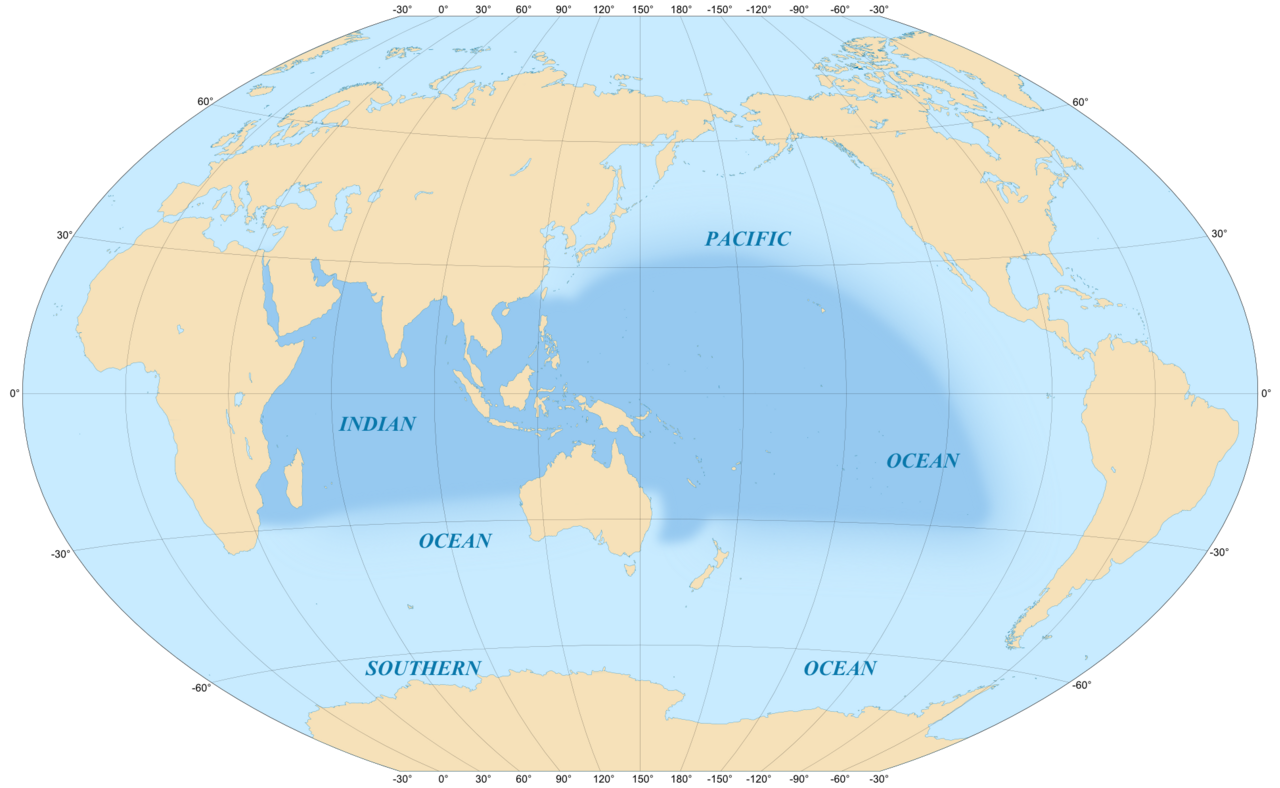
The Indo-Pacific is the world’s largest and most biologically diverse marine region, stretching from the eastern coast of Africa across the Indian Ocean and western Pacific Ocean to Hawaii and French Polynesia, and from southern Japan to northern Australia. It contains thousands of islands, extensive coral reefs, mangrove forests, seagrass meadows, and open ocean habitats.
This region is home to the Coral Triangle, often called the “Amazon of the Seas,” which contains the greatest diversity of corals, reef fishes, sharks, sea turtles, and other marine life found anywhere on Earth. Warm tropical waters, abundant sunlight, and interconnected ocean currents support some of the planet’s most productive and complex marine ecosystems.
Warm tropical saltwater (75-84°F / 24-29°C) with high salinity, abundant sunlight, excellent water clarity, and moderate ocean currents. Most species inhabit the Sunlight Zone (0-200 m / 0-656 ft) where sunlight supports photosynthesis and one of the most productive marine ecosystems on Earth.
- Connected Ecosystem: The Open Ocean exhibit represents a connected tropical marine ecosystem where coral reefs, reef slopes, coastal waters, and adjacent open ocean function together rather than as isolated habitats.
- Ecological Niches: Animals occupy different ecological niches, allowing many species to share the same habitat with minimal competition. Sharks patrol open water, green sea turtles move between reef and coastal habitats, while reef fishes occupy different areas of the reef and water column.
- Herbivores: Tangs, rabbitfish, unicornfish, and green sea turtles graze algae and marine vegetation, helping maintain healthy reef and seagrass ecosystems.
- Predators: Sharks, groupers, snappers, jacks, and moray eels help regulate fish and invertebrate populations, contributing to a balanced ecosystem.
- Life Stages: Many reef fishes use different habitats throughout their lives. Juveniles often develop within the protection of coral reefs before moving into larger coastal and open-water habitats as adults.
- Habitat Connectivity: Ocean currents connect reefs across the Indo-Pacific by transporting nutrients, plankton, and the larvae of many marine species. This connectivity helps maintain healthy populations throughout the region.
- Primary Producers: Phytoplankton, marine algae, and other photosynthetic organisms capture sunlight and form the foundation of the food web.
- Primary Consumers: Green sea turtles, tangs, rabbitfish, and unicornfish graze algae or marine vegetation, converting plant material into energy for higher trophic levels.
- Secondary Consumers: Angelfish, butterflyfish, wrasses, flagtails, and other reef fishes feed on plankton, algae, small invertebrates, or a combination of food sources depending on the species.
- Predatory Fishes: Groupers, snappers, jacks (trevallies), puffers, and moray eels feed on fishes, crustaceans, mollusks, and other marine animals.
- Apex Predators: Reef sharks occupy the highest levels of the food web, while some species, such as zebra sharks, specialize in feeding on bottom-dwelling invertebrates and small fishes.
- Balanced Ecosystem: Because each species feeds differently and occupies a unique ecological role, competition is reduced and a greater diversity of animals can coexist within the same ecosystem.
- Streamlined Bodies: Sharks, trevallies, and many reef fishes have streamlined bodies that reduce drag and improve swimming efficiency.
- Camouflage: Zebra sharks blend into sandy bottoms and reef habitats, while many reef fishes use coloration to hide among corals or communicate with one another.
- Specialized Feeding: Butterflyfish have narrow snouts for feeding within coral crevices. Rabbitfish and tangs possess teeth adapted for grazing algae, while puffers use powerful beak-like teeth to crush hard-shelled prey.
- Sensory Systems: Sharks possess an exceptional sense of smell, can detect tiny electrical signals produced by prey (electroreception), and use their lateral line to detect vibrations in the water.
- Schooling Behavior: Species such as golden trevallies and barred flagtails often travel in groups, improving predator detection and increasing foraging efficiency.
- Defensive Adaptations: Rabbitfish possess venomous dorsal spines for protection, while puffers rely on inflation and strong jaws to deter predators.
- Efficient Swimming: Forked tails, rigid fins, and streamlined body shapes allow many open-water fishes to travel long distances while conserving energy.
- Biodiversity Hotspot: The Indo-Pacific contains the highest diversity of marine species on Earth.
- Healthy Food Webs: Predators, herbivores, and prey species work together to maintain balanced marine ecosystems.
- Coral Reef Communities: Coral reefs provide food, shelter, nursery habitat, and breeding areas for thousands of marine organisms.
- Human Benefits: Healthy oceans support fisheries, tourism, coastal protection, scientific research, and the livelihoods of millions of people.
- Global Ocean Health: Healthy tropical oceans contribute to nutrient cycling, carbon storage, and the long-term resilience of marine ecosystems.
- Marine Protected Areas: Governments and conservation organizations establish protected areas where fishing and habitat destruction are limited.
- Sustainable Fisheries: Science-based fishing regulations help maintain healthy fish populations while supporting local communities.
- Coral Restoration: Scientists and aquariums grow and transplant corals to restore damaged reef ecosystems.
- Wildlife Research: Researchers monitor shark, turtle, and fish populations to better understand migration, reproduction, and conservation needs.
- Rescue & Rehabilitation: Injured sea turtles and other marine wildlife receive medical care and, when possible, are returned to the wild.
- Public Education: Zoos, aquariums, and conservation organizations inspire people to protect oceans through education and community outreach.
- Reduce Plastic Waste: Use reusable bags, bottles, and containers to help keep plastics out of waterways.
- Choose Sustainable Seafood: Look for seafood certified by organizations such as the Marine Stewardship Council (MSC) or recommended by Seafood Watch.
- Choose Shark-Friendly Products: Some cosmetics, supplements, and other products contain squalene derived from shark liver oil. Choosing products made with plant-derived squalane or other sustainable alternatives helps reduce pressure on shark populations.
- Recycle Fishing Line: Dispose of fishing line properly to reduce entanglement of turtles, birds, and marine mammals.
- Reduce Your Carbon Footprint: Conserving energy and reducing emissions helps protect coral reefs from climate change.
- Support Conservation Organizations: Donate to or volunteer with accredited aquariums, conservation organizations, and local watershed groups.
- Protect Local Waterways: Everything that enters local streams and rivers can eventually reach the ocean. Properly disposing of chemicals, picking up litter, and participating in local stream cleanups helps protect marine ecosystems downstream.
Guest Engagement
Encyclopedia
Lasted Updated